Why Ignoring Cart Recovery Is Costing Your E-Commerce Business More Than You Think
For many e-commerce businesses, abandoned carts are viewed as an unfortunate but inevitable part of the sales cycle. The common thinking goes something like this: “Some customers will drop off. We’ll rely on ads and promotions to bring new traffic and hope for a solid return on ad spend (ROAS).” But this approach misses a critical and fairly straightforward revenue opportunity lurking in plain sight.
Ignoring cart recovery isn’t just a missed tactic; it’s a fundamental operational gap. The real problem isn’t the abandonment itself. It’s the absence of a system designed to reclaim those lost sales. Without a deliberate, repeatable process, you are essentially letting 5-15% of your potential monthly revenue slip through your fingers. This loss often goes unnoticed because it’s scattered and untracked.
This post breaks down why the typical approach falls short, uncovers the real operational issue underlying abandoned carts, shows the correct framework to address it, and offers practical examples to help you shift those lost carts back into your revenue pipeline.
Why the Standard Approach to Abandoned Carts Falls Short
Most e-commerce businesses rely heavily on paid ads to drive sales. When they see abandoned carts, the reflex is often to increase ad spend, assuming more traffic will compensate for lost conversions. But this strategy has limitations:
- It treats symptoms, not causes. Ads bring visitors but don’t address why customers don’t complete purchases.
- It neglects post-visit engagement. Once a potential customer leaves the cart, without a follow-up system, the chance to recapture them evaporates.
- It misses the size of the opportunity. 5-15% of monthly revenue leaking to abandoned carts is substantial—and recoverable.
Simply put, advertising alone isn’t enough. Even with good ROAS, ignoring cart recovery means leaving millions—or thousands—on the table every month.
The Real Underlying Issue: Lack of a Structured Recovery System
The problem of lost cart revenue doesn’t stem from customer behavior alone. It stems primarily from operational gaps and a lack of discipline in post-cart follow-up:
- No repeatable process. Many businesses don’t have a defined procedure for recovering abandoned carts, relying instead on ad hoc efforts or sporadic emails.
- No centralized tracking. Without capturing data on recovered carts and revenue, it’s impossible to measure the effectiveness of any recovery efforts.
- Misallocation of resources. Too often, marketing budgets push for new customer acquisition but fail to invest in recovering existing potential sales.
- Poor timing and follow-up. Cart recovery needs quick, well-timed touchpoints after abandonment—not generic or delayed outreach.
The underlying issue is clear: lacking a system means abandoned carts are neither prioritized nor managed effectively, causing predictable revenue leakage.
A Practical Framework for Effective Cart Recovery
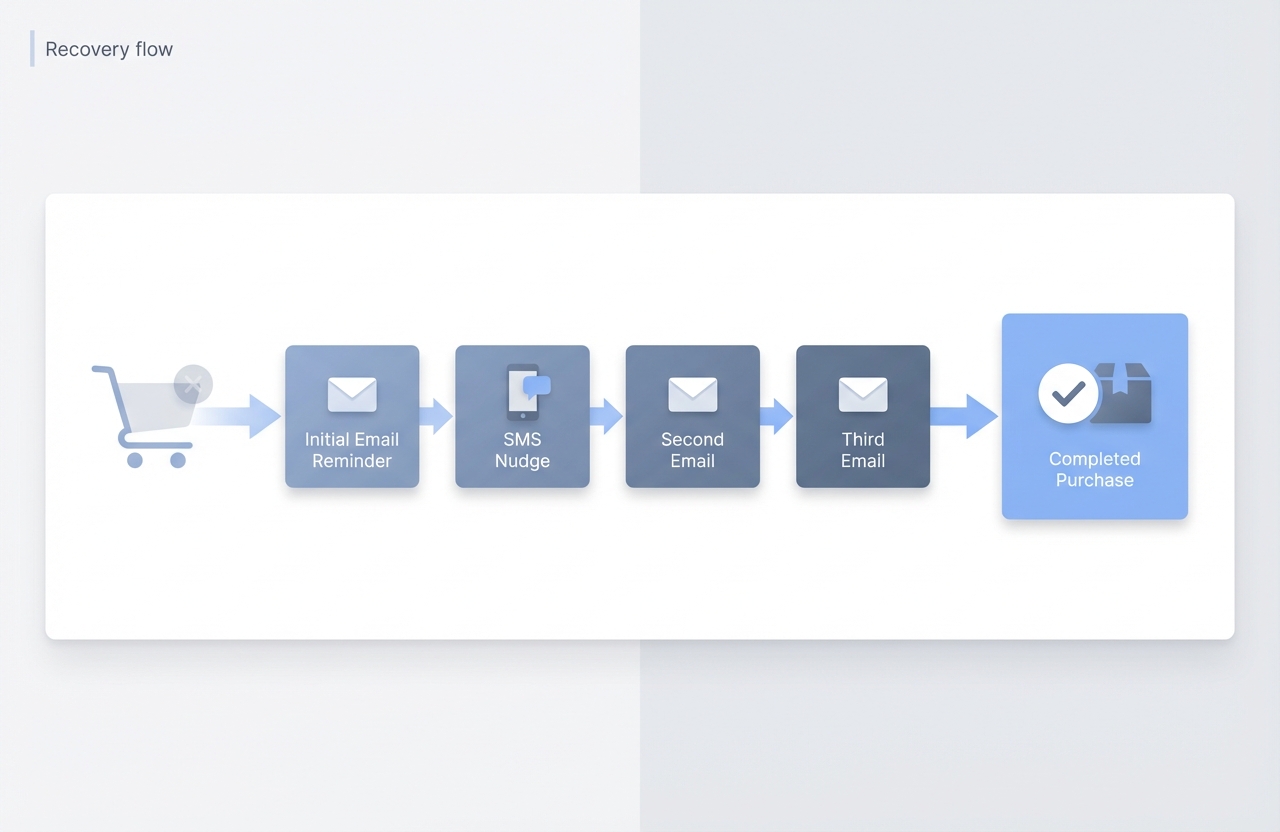
Addressing abandoned carts requires a shift in mindset—from accepting loss as normal to building operational discipline around recovery. A simple but disciplined workflow can turn this around. Here’s an effective framework:
- Automated Email Sequence
Deploy a 3-step email series targeting customers who abandon their carts:- First email within 1 hour — a reminder with the cart items visible.
- Second email within 24 hours — possibly with an incentive or FAQ to preempt objections.
- Third email within 72 hours — a final reminder, emphasizing scarcity or social proof.
- Timely SMS Nudge
Supplement emails with a short SMS message about 2-4 hours after abandonment. SMS is direct, and the immediacy can nudge customers back when they are still considering the purchase. - Centralized Revenue Tracking
Integrate cart recovery data into your core reporting systems:- Track recovered revenue separately.
- Analyze which messages and timings perform best.
- Use data to refine frequency and content.
This framework isn’t complicated or cutting edge—it’s operational discipline: a clear, repeatable process that follows the customer from abandonment toward completion, coupled with data to measure impact.
Real Examples from Operations
To show how this works in practice, here are examples from actual e-commerce operations:
- Mid-sized fashion retailer
This company implemented a 3-step email recovery sequence plus SMS reminders. Within the first 2 months, recovered cart revenue accounted for a consistent 7% of total monthly sales. The key was the 1-hour first email and an SMS reminder 3 hours after abandonment. They tracked recovered revenue in their analytics dashboard for continuous optimization. - Specialty food and beverage brand
Before implementing a structured system, they saw 12% monthly cart abandonment. After rolling out disciplined follow-up with segmented messaging and tracking recovered revenue, they recaptured about 10% of lost carts, translating to an additional $40K monthly. They recognized that disciplined execution was more effective than increasing their ad budget. - B2B office supplies supplier
This operator found that abandoned cart recovery was overlooked in favor of sales outreach and cold prospecting. Introducing a simple cart recovery framework allowed them to reclaim unnoticed revenue. They paired automated emails with personalized SMS follow-ups in accounts where identified decision-makers had abandoned carts, improving sales efficiency without added ad spend.
Conclusion: Systems Before Tools
Viewing abandoned carts as an unavoidable cost is a mistake. It masks an opportunity that only becomes visible when you build consistent, operationally sound systems for recovery.
The solution does not begin with more ads or fancy marketing tactics. It begins with a clear, repeatable process: timely, automated email sequences combined with SMS nudges, backed by rigorous tracking and measurement. This kind of operational discipline recovers a meaningful portion of lost revenue each month.
Ultimately, recovering abandoned carts is not about a tool or channel. It’s about instilling the right system inside your business. When you prioritize that system, the revenue follows—in a reliable, measurable way.