Building software businesses has long seemed like a two-step hurdle:
First, you need the technical skills to build the product, and second, the business acumen to grow it.
AI is upending the first part by dramatically lowering the barrier to coding. But this shift often leads to a mistaken assumption that if building the software is easier, building the business will be easier too.
The reality is simpler and less glamorous:
AI is removing the need for strong coding skills in many app categories, but it does not remove the need for clear thinking, focused execution, and persistent effort to create meaningful business outcomes.
The bottlenecks have moved. And understanding where the pressure points truly lie is key if you want to build something big.
Why the Old “Need a Developer” Problem Is Disappearing
For decades, many founders and operators with strong domain ideas were stuck because they lacked technical skills.
They don’t know how to code, can’t find a trustworthy developer cofounder, or can’t afford a dev team. As a result, many business ideas never leave the concept stage.
Recent advances, call it AI paired with integrated platforms like Replit, are quietly dismantling this barrier.
You can now:
- Describe your app idea in natural language
- Have the AI generate code, user interfaces, deployment scripts, and even payment integrations
- Iterate by dialoguing with the AI much like you would a junior engineer
This is not hype… it’s a tangible change.
Someone like a CFO at a VC firm, armed with deep domain expertise but zero coding skills, can now build a production-quality app over a few months and even sell it. The “I need a developer” hurdle is no longer an absolute blocker for a broad class of business applications.
But this change only shifts the challenge—it doesn’t erase it.
The Real Bottleneck Isn’t Technical—It’s Intellectual and Operational
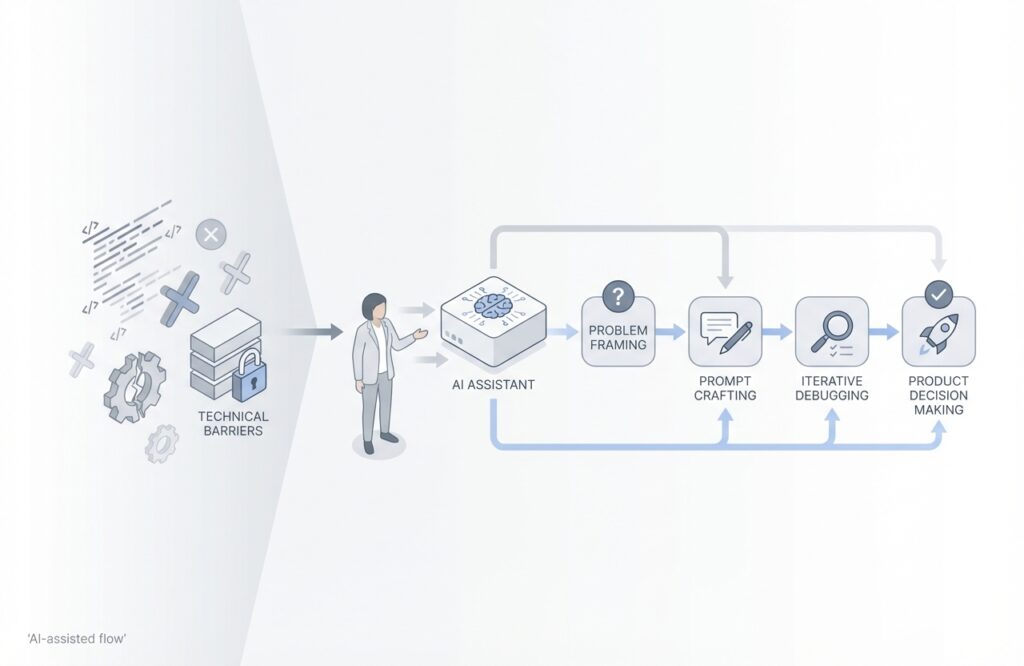
Although AI can now write code, a business doesn’t run on code alone. The real sticking points are:
- Precise communication and problem formulation. You have to be able to translate business problems into high-quality prompts that guide the AI effectively. This is prompting a new kind of programming, less about syntax, more about specifying behaviors, constraints, and outcomes clearly.
- Debugging and iteration. AI-generated code is not perfect. You’re still responsible for diagnosing issues, analyzing logs, testing workflows, and refining both product and prompts. The AI acts like an intern who can do many things but lacks intuition.
- Product decision-making. Prioritizing features, defining user experience, and deciding “what to build first” remain human tasks. AI helps execute but does not replace judgment or strategy.
The shift here transforms developers into product managers, tech leads, and domain experts who direct an AI assistant. Success requires better communication and systems thinking, not raw coding skill.
The Framework for Building Something Big
If code is no longer the main challenge, what drives big outcomes?
- Domain expertise. AI can remix known patterns and formats but cannot invent deep insights or nuanced understanding about complex business processes. This tacit knowledge—what you know from experience—remains the real edge.
- Relentless resourcefulness. The founders who succeed are those who can learn on the fly, seek out tutorials, experiment repeatedly, and find ways around obstacles. This grit and adaptability are more important than ever as you navigate new tools and evolving product requirements.
- Persistence through ambiguity and failure. Overnight success stories obscure the reality of long hours debugging, iterating, and refining. Building something significant means showing up again and again, stepping through discomfort and uncertainty.
- Entrepreneurship beyond shipping. Building software is a step, not the finish line. Customer acquisition, revenue models, distribution channels, and branding are still the hardest parts. AI helps you build faster, but it does not replace the need to sell, negotiate, or scale.
The mental model shifts from “Can I build this technically?” to “Can I think strategically, execute operationally, and persist over time?”
Practical Examples from Real Operations
Consider a founder with domain expertise in physiotherapy clinics. Traditionally, launching custom software to optimize patient scheduling or billing meant hiring developers, managing projects, and allocating significant budget.
Now, with AI-assisted development:
- The founder describes workflows and requirements in natural language.
- The AI builds an MVP that automates reminders, tracks visits, and syncs with billing.
- The founder iterates on UX based on clinician feedback, refining prompts to tweak the AI’s output.
- Simultaneously, they focus on building relationships with clinics, measuring net promoter scores, and trialing the software in live environments.
Another example is the growing niche of “vibe coding,” where product managers with no coding background leverage AI as a fast but naive junior developer. They:
- Construct clear, incremental prompts reflecting product logic
- Experiment with the interface and business rules
- Review and debug outputs by interpreting error logs
- Drive the roadmap based on customer feedback instead of technical whims
These examples highlight how AI accelerates execution but requires human judgment, communication, and domain insight to transform a project into a sustainable business.
Conclusion: Build Systems, Not Just Code—Focus on What Matters
AI removes one barrier: technical skill for many business apps. But it does not remove the need for disciplined thinking, resourcefulness, product judgment, and persistence. The biggest leverage has shifted from “Can you code?” to “Can you run a system where AI is a tool, and you provide the insight, direction, and resilience?”
If you want to build something substantial:
- Start with a domain you deeply understand.
- Use AI to accelerate building, not as a crutch to avoid thinking.
- Own the whole system—product, metrics, distribution, and customer relationships.
- Bring grit, adaptability, and patience to the process. These remain irreplaceable.
Code is no longer the limiting factor in launching software businesses at scale. The human ability to strategize, execute, and endure still defines who wins. That is the mental model and the reality operating teams and founders must embrace today.