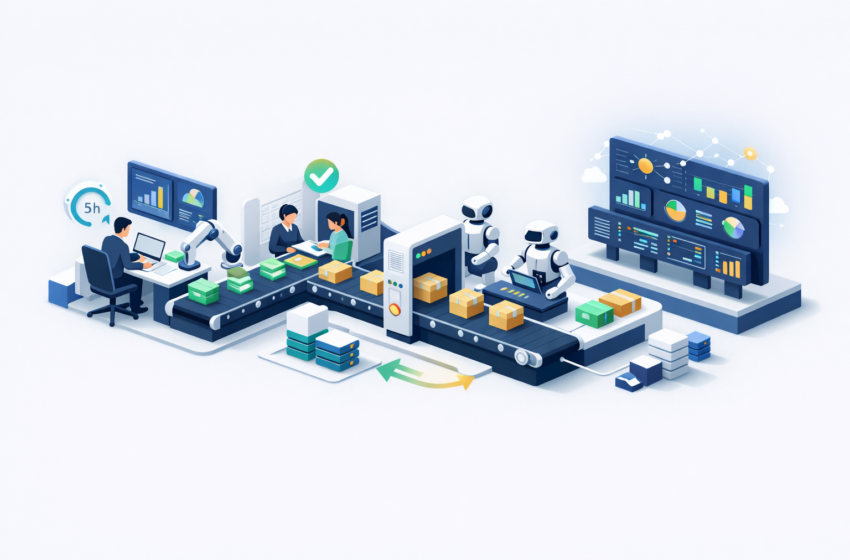
AI adoption ladder: assist → optimize → automate (agents) → systematize
How enterprises are actually adopting AI, where ROI is now showing up, and which use cases and teams are pulling ahead.
NLW (CEO of Super.ai) shares what he sees from exec interviews, plus a month-long ROI survey of ~3,500 AI use cases reported by ~1,000 orgs.
What’s happening with AI in enterprises
→ AI is Growing Fast (But Most Companies Are Still Testing It)
Using Artificial Intelligence (AI) is becoming very popular, especially for writing computer code and managing tech systems.
“AI Agents” → smart programs that can perform tasks on their own are moving from the testing phase to real-world use much faster than people expected.
A survey by KPMG found that at huge companies (those making over $1 billion), the use of these agents jumped from 11% at the start of the year to 42% by the autumn.
Here is where things stand right now:
- Still Testing: Even though AI is popular, most companies are still just experimenting with it. According to McKinsey, only about 7% of companies say they are using AI fully across their whole business. Bigger companies are generally ahead of smaller ones.
- Spending More: Companies are ready to spend big money.
Over 90% of them plan to increase their AI budgets in the next 12 months. - Bosses Want Results: CEOs are getting impatient.
They want to see a “Return on Investment” much sooner.- Most CEOs (67%) expect to see results in 1 to 3 years.
- A surprising number (19%) now want to see results in just 6 to 12 months.
Where ROI is showing up right now
→ Is AI Worth the Money? (Measuring Success)
When companies spend money on AI, they look for “ROI”.
How companies measure that value:
- The Main Benefits: It’s not just about making more money. Companies also look for time savings, getting more work done, making fewer mistakes, and making smarter decisions.
- Saving Time is #1: The most common reason companies start using AI is simply to save time. About 35% of companies say this is their main goal.
The Math of Saving Time. This is the most impressive part. AI usually saves employees between 1 and 10 hours of work per week.
- The most common result is saving 5 hours a week.
- If you add that up, it equals 7 to 10 full weeks of work saved per person every year! That is a huge amount of free time gained, even before the company makes any extra profit.
So, is it working? When asked how much value they are getting back right now:
- 44% said they are seeing “modest” (okay/decent) results.
- 38% said they are seeing “high” (amazing) results.
- 5% said it’s “negative” (this usually just means they are still spending money to set it up and haven’t earned it back yet).
Overall, almost everyone expects the results to be extremely high by next year.
Use cases that outperform
→ Where AI Works Best (and the Hidden Superpower)
Not all AI projects are equal. Some types of work get much better results than others.
1. AI “Agents” Bring the Biggest Wins When companies use “AI Agents” (software that can do tasks automatically without human help), they see the highest success rates.
- Examples: Sorting customer support messages (ticket triage), checking if company rules are being followed, or matching up messy data.
- The Result: These automated assistants are changing how businesses work completely.
2. Coding is the Leader The best place to use AI right now is in Software Engineering and IT.
- Why? Because with coding, you get instant feedback, the code either works or it doesn’t. It is easy to measure success, and the tools available for coders are very advanced.
3. The Secret Weapon: Reducing Risk Very few companies (only about 3.4%) say their main goal is “Risk Reduction” (making sure they don’t get in trouble or make dangerous mistakes).
- The Surprise: Even though few people focus on this, those who do get incredible results.
- Why? AI is amazing at boring, repetitive tasks like reviewing thousands of legal documents or audits. It can spot problems that humans might miss because they get tired.
Who’s pulling ahead
The Winners vs. The Followers
The gap between the “Leaders” (companies winning at AI) and the “Laggards” (companies falling behind) is getting bigger.
1. How Leaders Think Successful companies don’t just do small, lonely science experiments in one corner of the office. They think about the whole system. They create strategies that connect different teams across the entire company.
2. What the Top Bosses Want The “C-Suite” (top executives like the CEO and CFO) are changing their focus.
- Old Focus: “How much time can we save?”
- New Focus: “How much more can we create? What new things can we do? How can we make more money?”
3. Small vs. Big Companies
- Small Organizations: They are “nimble” (quick and agile). Because they are small, they can sometimes completely transform their business faster than anyone else.
- Large Organizations: They move a bit slower, but they are much better at scaling up—meaning they can take an AI tool and successfully roll it out to thousands of employees in an organized way.
A Simple 4-Step Plan
Here is a simple “ladder” of steps you can climb to make AI work for your team.
Step 1: Start with Speed (The Baseline). Focus on saving time first. Use AI assistants to help write content, organize data, or answer simple questions.
- The Goal: Save about 5 hours a week per person.
- How to measure it: Check if people are hitting their daily goals faster.
Step 2: Upgrade Quality Once you are faster, focus on being better. Use AI templates and checking tools to make sure everyone’s work is high-quality and consistent. This helps you get more done without making mistakes.
Step 3: Bring in the “Agents.” Now, let the AI take over entire tasks. If a job has clear rules and happens a lot (like sorting emails or checking forms), let an AI Agent do it automatically.
- The Result: This is where you see a huge jump in value (ROI).
Step 4: Make it a System. Don’t just run a few experiments. Connect your data, train your employees, and make rules for how to use AI safely. Winners treat this like a serious, long-term program, not a one-time school project.
How to Picture This (The Factory Analogy)
Think of adopting AI like building a car on a factory assembly line:
Station 1 (Assistants): A human worker uses a power tool instead of a hand tool. They work faster. (This is Time Savings).
Station 2 (Quality): The worker uses a mold or a guide to make sure every part looks the same. (This is Quality Control).
Station 3 (Agents): A robotic arm takes over the heavy lifting and repetitive welding completely. (This is Automation).
The Manager: The leader’s job is to watch the whole floor and make sure the humans and robots are working together smoothly.