Agentic workflows are AI-driven systems that autonomously do multi‑step work, improving results through loops of plan–act–reflect.
What an agentic workflow is
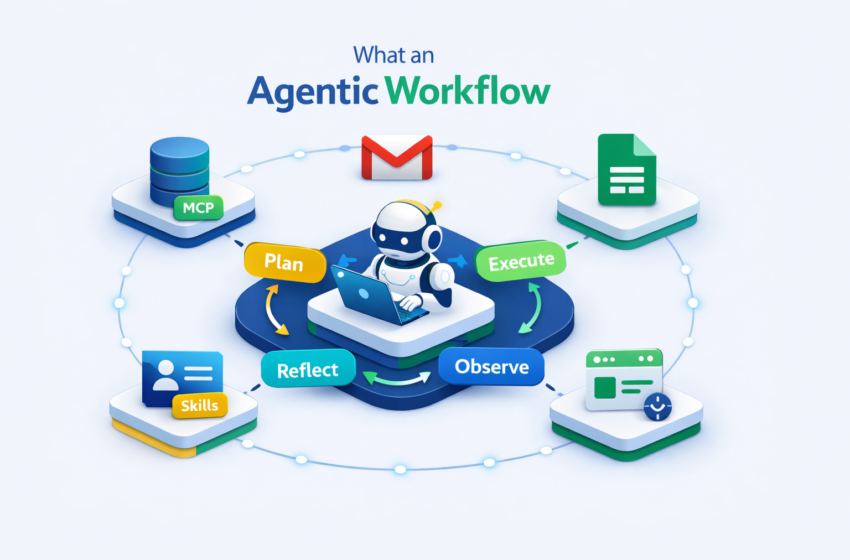
Think of an agentic workflow like a capable assistant you brief once, and it runs the whole task: it plans steps, uses tools (web, APIs, email), keeps notes, checks its work, and adjusts until done. Instead of single prompts, it’s a self-directed loop:
plan → execute → observe → reflect → continue.
Why this matters (horizontal leverage)
Traditional automation replaces 100% of one narrow role. Agentic workflows aim to automate roughly “90% of 10,000 roles” across the org—freeing many people from repetitive work and multiplying output. That’s horizontal leverage: like switching from hand‑sewing to reconfigurable looms you can reshape with plain language.
Core building blocks
- Planning: Turn a goal into steps and contingencies.
- Tools: Connect to databases, CRMs, Gmail, Sheets, scrapers via standards like MCP and Skills.
- Memory: Store context, partial results, and decisions to avoid rework.
- Reflection: Check outputs, compare against objectives, correct errors.
- Orchestration: Coordinate multiple sub‑agents or parallel tasks for speed.
Simple example
An agent to find five Vancouver meal‑prep companies, discover emails, and send customized inquiries with calorie/protein specs. The agent searches, broadens when a site lacks emails, builds a temporary list, and then sends five tailored emails end-to-end with minimal human input. That’s the loop adapting to obstacles.
Interfaces: from GUIs to language
Classic automations use drag‑and‑drop nodes in n8n. Agentic systems let you describe the workflow in natural language bullets, the agent executes and can be reconfigured instantly by editing the text plan. It’s like replacing wiring diagrams with a living SOP the system follows.
Reliability: self‑annealing
LLMs are probabilistic, so reliability comes from processes: explicit prompts, tool constraints, validation checks, retries, and “self‑annealing” loops… agents notice when outputs drift and heal the workflow (e.g., broaden search, skip invalid leads, re‑query APIs).
Scaling patterns
- Parallelization: Run many agents or tasks at once (e.g., lead scraping at scale).
- Sub‑agents: Specialized helpers (scraper, emailer, CRM updater) coordinated by a manager.
- Cloud + scheduling: Deploy via webhooks and timers so workflows run autonomously day‑to‑day.
Mental model for business impact
Imagine a river of value (work that earns money).
Agentic workflows carve new channels by turning multi‑step cognitive labor into fast, repeatable loops.
With better models, standardized tool access (MCP), and lower cost, the “arbitrage window” is open: those who adopt now capture outsized flow until the market catches up.